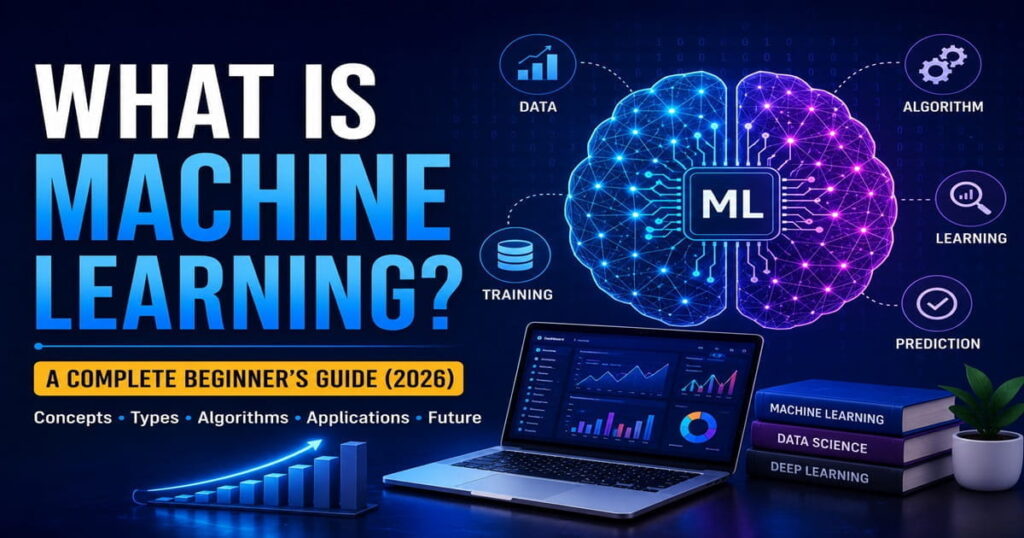
What Is Machine Learning?
Machine Learning (ML) is among the fastest growing technologies and makes up an integral part of today’s Artificial Intelligence (AI) revolution. From the Netflix recommendation of your next hit movie to the banks checking for any fraudulent activity, Machine Learning makes several technologies we depend on daily intelligent.
If you’re a novice in the domain, then no worries as this comprehensive guide gives a detailed insight into what Machine Learning is, its working process, types, pros, cons, applications, and future trends.
For example:
- Email services detect spam messages.
- Streaming platforms recommend movies and TV shows.
- Shopping websites suggest products you may like.
- Banks identify suspicious financial transactions.
All of these are common applications of Machine Learning.
How Does Machine Learning Work?
Machine Learning uses the following procedure:
Data Gathering
Data is obtained from databases, websites, sensors, or interaction with users.
Data Processing
The data is then processed to make it ready for analysis.
Model Training
The data is analyzed by the machine learning algorithm to identify any trends.
Model Testing
The machine learning model is tested using new data to assess its performance.
Prediction
When the model is ready, it is used to predict results and make decisions based on new data.
Improved Accuracy
With more data being gathered, the model accuracy will keep improving.
Types of Machine Learning
Supervised Learning
Supervised learning is when the model learns from the data that is labeled, and the right answer is available.
Example:
- E-mail spam filtering
- Housing price prediction
- Weather forecasting
Unsupervised Learning
Unsupervised learning involves analyzing the unlabeled data to find patterns in them.
Example:
- Market segmentation
- Recommendations
- Market analysis
Reinforcement Learning
Reinforcement learning is when the model is trained using incentives and punishments. The model learns through interaction with the environment.
Example:
- Autonomous vehicles
- Robotics
- Game playing AI
Common Machine Learning Algorithms
The following are some popular machine learning algorithms used:
- Linear Regression
- Logistic Regression
- Decision Tree
- Random Forest
- Support Vector Machines (SVM)
- K-Nearest Neighbors (KNN)
- Naive Bayes
- Neural networks
Each of the above algorithms can be used depending upon the problem and type of data.
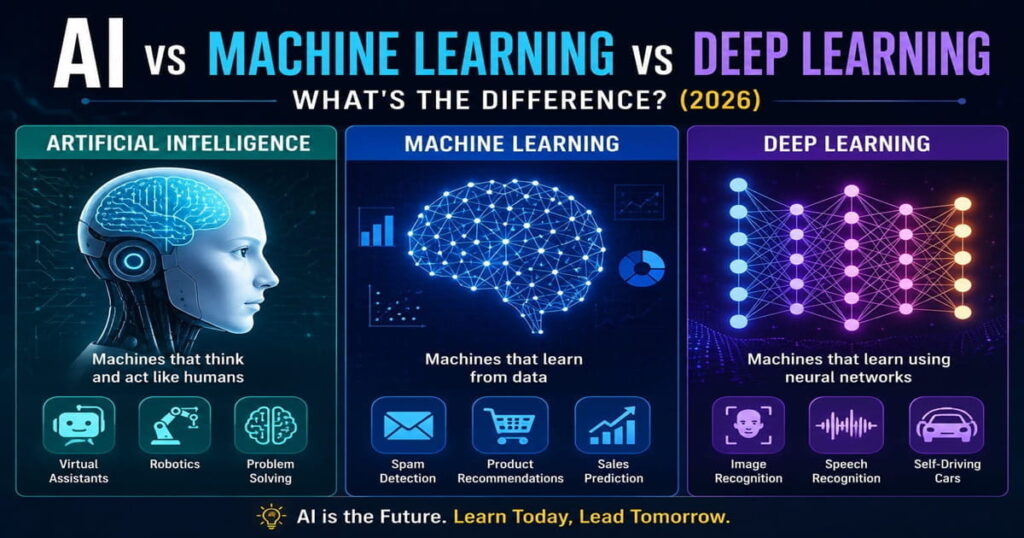
Machine Learning vs Artificial Intelligence
Many beginners confuse AI and Machine Learning.
| Artificial Intelligence | Machine Learning |
|---|---|
| A broad field focused on creating intelligent systems | A subset of AI that enables systems to learn from data |
| Includes reasoning, planning, language understanding, and more | Focuses on recognizing patterns and making predictions |
| Covers many technologies | One important technology within AI |
To put it simply, all Machine Learning belongs to the domain of Artificial Intelligence, whereas all Artificial Intelligence does not use Machine Learning.
Machine Learning in Real Life
Machine Learning is something that we use in our daily life.
Some examples of this are:
- Search engine ranking
- Virtual assistants
- E-commerce product recommendations
- Social media content recommendation
- Translation services
- Detecting frauds
- Facial recognition
- Navigation and traffic predictions
- Personalized advertisement
Applications of Machine Learning
Machine Learning is revolutionizing many different sectors.
Healthcare
- Predicting diseases
- Analyzing medical images
- Drug development
- Patient monitoring
Finance
- Credit scoring
- Fraud detection
- Investment analysis
- Risk assessment
Education
- Customized learning
- AI tutors
- Assessing student performance
Retail
- Recommendation systems
- Predicting inventory needs
- Analysis of customer behavior
Manufacturing
- Predictive maintenance
- Quality control
- Process optimization
Digital Marketing
Machine Learning aids in enhancing digital marketing by:
- Analyzing customer behavior
- Optimizing SEO techniques
- Creating personalized email campaigns
- Generating product recommendations
- Enhancing advertisement performance
- Creating smarter content recommendations
Advantages of Machine Learning
There are numerous advantages associated with Machine Learning.
Decision-Making
Machine Learning makes quick analyses of huge amounts of data and gives valuable insights.
Accuracy
Properly trained models can give high levels of accuracy.
Automation
Machine Learning automates numerous repetitive processes.
Enhanced Customer Experience
Companies can provide personalized experience.
Continuous Improvement
Machine Learning learns and improves with increasing quality data.
Disadvantages of Machine Learning
However, despite all advantages, there are certain limitations associated with Machine Learning.
- Machine Learning requires big amount of data.
- Model training takes time.
- Development is costly.
- Poor data can decrease accuracy.
- Some models are hard to understand.
- Privacy and Security issues must be solved.
Future of Machine Learning
Machine Learning is expected to take a very significant role in the future.
In the future there can be:
- Better virtual assistants
- Advanced diagnostics in medicine
- Self-driven transport vehicles
- Better cyber security
- Custom education
- Smart business automation
- Better generative artificial intelligence
As new technologies emerge, Machine Learning will continue to shape the future of businesses and life of individuals.
Tips for Beginners
For those who are interested in Machine Learning:
- Know how to code, especially in Python
- Have understanding of mathematics and statistics
- Be aware of the basics of data analysis
- Work on projects for beginners
- Investigate open source Machine Learning platforms
- Stay up to date with the newest trends in AI and ML.
Progressive learning is always the best approach.
Frequently Asked Questions (FAQs)
What is Machine Learning in simple words?
Machine Learning is a technology that allows computers to learn from data and improve their performance without being explicitly programmed for every task.
Is Machine Learning part of AI?
Yes. Machine Learning is one of the most important branches of Artificial Intelligence.
Where is Machine Learning used?
It is used in healthcare, finance, education, retail, manufacturing, digital marketing, transportation, entertainment, and many other industries.
Which programming language is best for Machine Learning?
Python is considered the most popular programming language for Machine Learning because of its simplicity and powerful libraries.
Can beginners learn Machine Learning?
Yes. Beginners can start by learning programming, mathematics, and data analysis before moving on to Machine Learning concepts.
Conclusion
Machine Learning is transforming the way computers solve problems, make predictions and assist in decision-making. Its uses keep increasing year after year in areas ranging from health care and finance to digital marketing and entertainment.
Machine Learning knowledge is one of the essential things that must be learned before exploring more recent technologies like Artificial Intelligence. Regardless of the field in which you work or the subject you are interested in, learning Machine Learning may come in handy.
Before embarking on deepening your knowledge by studying Deep Learning and Generative AI, make sure you understand all basics discussed in this guide.
Read More…….
What Is Artificial Intelligence (AI)? A Complete Beginner’s Guide (2026)
What is Digital Marketing? Complete Beginner Guide (2026)
SEO for Beginners: Complete Step-by-Step Guide (2026)
Content Marketing Strategy: Complete Guide for Beginners
What Is Email Marketing? A Beginner’s Guide to Growing Your Business