AI, Machine Learning, and Deep Learning have been among the most popular topics of discussion in our times. Although all three technologies are commonly used interchangeably, there is a certain difference between the meanings of AI, ML, and DL.
ML is a branch of AI, while DL is an advanced technology that falls under ML. The relation among these technologies makes it easier for beginners and experienced individuals to comprehend AI, ML, and DL.
In this tutorial, we will help you understand the differences between AI, Machine Learning, and Deep Learning.
Introduction to Artificial Intelligence (AI)
Artificial Intelligence refers to the whole of computer science involved in the design of intelligent systems that can undertake actions which require human intelligence.
The activities may involve:
- Problem solving
- Decision-making
- Language understanding
- Image recognition
- Speech recognition
- Planning
- Learning from experience
AI focuses on enabling the machine demonstrate intelligence in various situations.
Examples:
A virtual assistant replying to your questions or chatbots assisting clients online.
Introduction to Machine Learning (ML)
Machine learning consists of a sub-area of artificial intelligence in which a machine learns from data and does not need programming for a particular action.
As opposed to rule-based methods, machine learning learns from data and gets better with time.
Examples:
- Detection of spam in emails
- Product recommendations
- Fraud detection
- Weather forecasting
Machine learning is among the most common AI techniques today.
What Is Deep Learning (DL)?
Deep Learning is an advanced version of Machine Learning that utilizes algorithms derived from neural networks of the human brain.
Deep Learning algorithms are able to analyze huge volumes of information and solve very complex tasks.
Examples include:
- Facial recognition
- Voice assistants
- Self-driving cars
- Medical imaging
- Translation services
Deep Learning usually requires bigger data sets and higher computational capacities than regular Machine Learning.
The Connection Between AI, ML, and Deep Learning
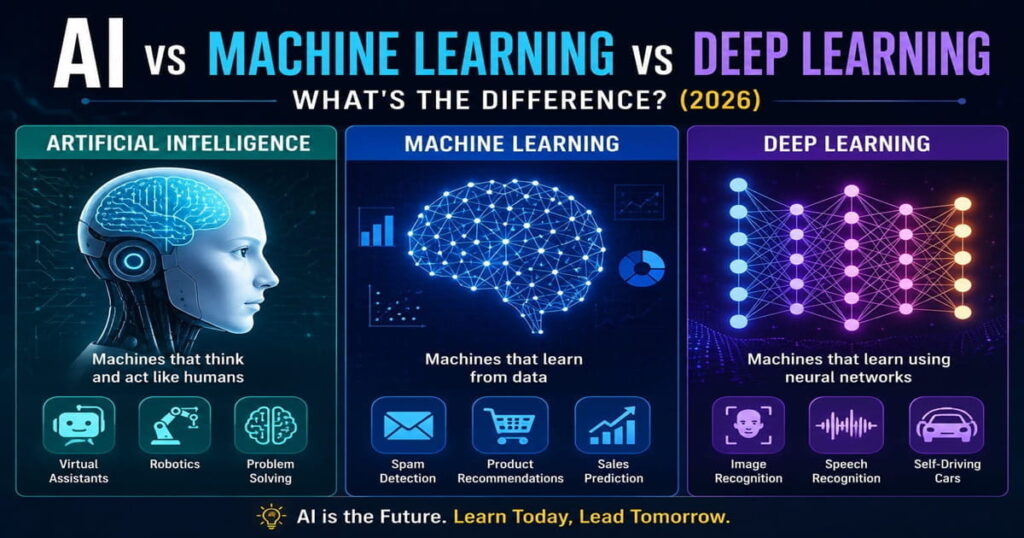
Imagine that they are a nested structure:
- AI – the biggest area.
- ML is a part of AI.
- Deep Learning is a part of Machine Learning.
All Deep Learning algorithms are Machine Learning algorithms, and all Machine Learning algorithms fall under the domain of Artificial Intelligence.
AI vs Machine Learning vs Deep Learning Comparison
| Feature | Artificial Intelligence | Machine Learning | Deep Learning |
|---|---|---|---|
| Definition | Broad field of intelligent systems | AI systems that learn from data | ML models using neural networks |
| Data Requirement | Low to High | Medium to High | Very High |
| Human Intervention | Higher | Moderate | Lower after training |
| Complexity | Broad | Medium | High |
| Training Time | Low to Medium | Medium | High |
| Hardware Requirement | Moderate | Moderate | High (often GPUs) |
| Best For | Intelligent automation | Predictions and pattern recognition | Complex image, speech, and language tasks |
Key Differences Explained
Scope
The broadest term is Artificial Intelligence.
Machine Learning involves learning using the data.
Deep Learning is specifically about learning using multi-layer neural networks.
Datasets
Not all traditional AI programs might need large datasets.
Machine Learning usually needs more data to perform well.
Deep Learning needs huge data sets to achieve accuracy.
Processing Power
The AI application does not need any specific computer.
Machine Learning needs extra processing power.
Deep Learning needs advanced GPU processing units or other specific hardware.
Learning Approach
AI uses either rules, logic, or some other approach to learn.
Machine Learning uses data and algorithms to learn.
Deep Learning learns automatically by extracting features from several neural network layers.
Problem Type
AI can solve easy and difficult problems.
Machine Learning solves prediction and classification type problems effectively.
Deep Learning handles complicated problems like images, video, audio, and natural language problems.
Examples of Real-World Applications
Artificial Intelligence
- Virtual assistance
- Customer service chatbots
- Smart homes
- Robotics
Machine Learning
- Product suggestions
- Spam detection
- Credit risk assessment
- Sales forecasting
Deep Learning
- Face detection
- Autonomous vehicles
- Voice detection
- Diagnostics from X-rays
- Artificial intelligence in image creation
AI Applications in Various Sectors
Healthcare
- Disease identification
- Imaging technology
- Drug development
Finance
- Fraud detection
- Risk assessment
- Predictive investments
Education
- Personalized education
- AI tutoring
- Analysis of student performance
Retail
- Suggesting products
- Demand forecasting
- Inventory management
Digital Marketing
Companies Apply AI, Machine Learning, and Deep Learning for:
- Improvement of SEO strategies
- Behavioral analysis of customers
- Personalization of email marketing
- Product recommendation
- Customer service automation
- Creation of ideas for content
- Optimization of advertising campaigns
Advantages and Disadvantages
Artificial Intelligence
Advantages
- Replicates tedious processes
- Increases efficiency
- Enhances decision-making capabilities
Disadvantages
- High cost of development
- Ethical issues
- Data privacy issues
- Machine Learning
Advantages
- Learns from information
- Increases precision
- Identifies unknown patterns
Disadvantages
- Requires high-quality information
- Can be biased
- Requires constant monitoring
- Deep Learning
Advantages
- Extremely precise for complicated jobs
- Manages unstructured information
- Automatically learns intricate patterns
Disadvantages
- Large volumes of data are required
- High costs of computation
- Not as understandable as other algorithms
Which Technologies should be learned first?
In case you are a beginner, consider following this path of learning:
Artificial Intelligence Basics
Machine Learning
Machine Learning Projects
Deep Learning
Generative AI, Large Language Models (LLMs)
Developing an effective foundation will make it easier to comprehend more advanced AI-related concepts.
Future Trends in AI, Machine Learning, Deep Learning
These technologies are predicted to revolutionize almost any area in the upcoming years.
The future will bring us such advances as:
- Enhanced healthcare
- Robotic advances
- Cybersecurity intelligence
- Personalized learning
- Improved AI assistance
- Self-driving vehicles
- Scientific discoveries
It is important to remember that responsible development and ethical use of AI will become more and more critical as it evolves.
Frequently Asked Questions (FAQs)
Is Machine Learning the same as Artificial Intelligence?
No. Machine Learning is one branch of Artificial Intelligence.
Is Deep Learning part of Machine Learning?
Yes. Deep Learning is a specialized branch of Machine Learning that uses neural networks.
Which is better: AI, Machine Learning, or Deep Learning?
None is universally better. They solve different types of problems and often work together.
Can beginners learn Deep Learning directly?
It’s recommended to first understand AI and Machine Learning before learning Deep Learning.
Where are these technologies used?
They are widely used in healthcare, finance, education, retail, transportation, manufacturing, cybersecurity, and digital marketing.
Conclusion
Artificial Intelligence, Machine Learning, and Deep Learning are all related concepts that have their unique roles and functions. AI refers to the creation of intelligent machines, while Machine Learning teaches machines how to learn, and Deep Learning solves very complex problems through the use of neural networks.
Knowing the distinctions between these technologies will enable you to select the correct study field and see how advanced technologies work to give us all the applications we use today. It doesn’t matter whether you are a student, a software developer, a company owner, or just someone interested in technology; knowing about AI, ML, and Deep Learning is essential for your future.
Read More………
What Is Artificial Intelligence (AI)? A Complete Beginner’s Guide (2026)
What Is Machine Learning? A Complete Beginner’s Guide (2026)
What is Digital Marketing? Complete Beginner Guide (2026)
SEO for Beginners: Complete Step-by-Step Guide (2026)
Content Marketing Strategy: Complete Guide for Beginners
What Is Email Marketing? A Beginner’s Guide to Growing Your Business