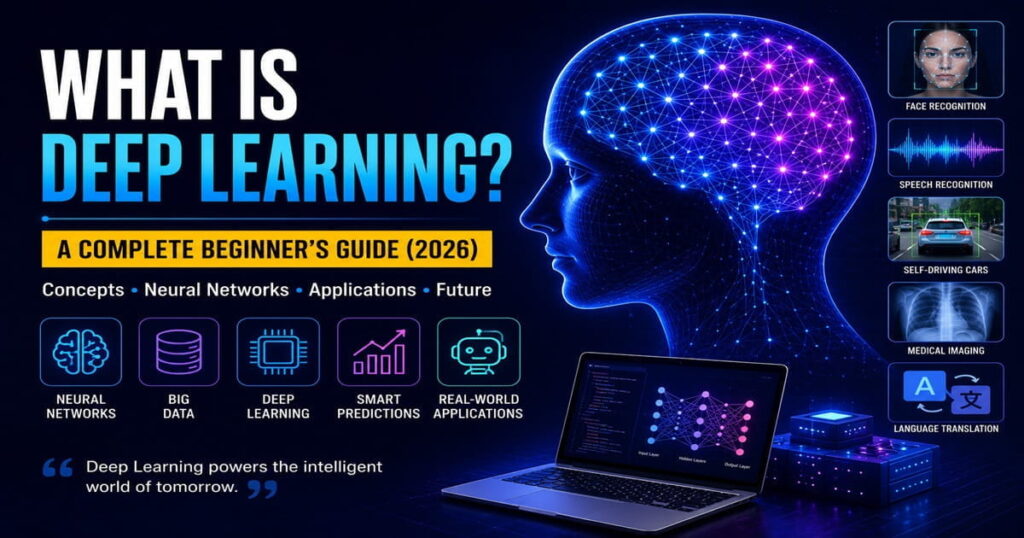
What Is Deep Learning?
Deep Learning is one of the most recent technologies that have been introduced in the domain of Artificial Intelligence (AI). It manages all the intelligent applications that we encounter on a daily basis such as voice assistants, facial recognition, machine translation, recommender systems, and even chatbots through the means of AI technology.
Deep Learning is one of the advanced subfields of Machine Learning, making use of neural networks in order to deal with enormous amounts of data and in solving difficult tasks extremely precisely.
This article will provide you with a comprehensive insight into Deep Learning and its characteristics if you are new to the realm of AI.
How Does Deep Learning Function?
Deep Learning algorithms learn using artificial neural networks that mimic the working of human brains.
This usually entails the following stages:
- Collecting huge amounts of data.
- Preparation and processing of this data.
- Data fed into a neural network.
- Information processed across several layers.
- Changing the parameters of the model for minimizing errors.
- Predictions made based on learning.
The larger and of higher quality the data, the better Deep Learning algorithms function.
What Is a Neural Network?
An Artificial Neural Network (ANN) serves as a basis for Deep Learning.
A neural network typically consists of:
- Input Layer – where data is entered.
- Hidden Layers – where information is processed and patterns recognized.
- Output Layer – where the prediction is generated.
It is the presence of several hidden layers that distinguishes Deep Learning from other types of machine learning.
Deep Learning vs Machine Learning
Although closely related, there are important differences.
| Machine Learning | Deep Learning |
|---|---|
| Requires some manual feature selection | Learns features automatically |
| Works well with smaller datasets | Performs best with large datasets |
| Faster to train | Takes longer to train |
| Lower computing requirements | Higher computing requirements |
| Easier to understand | More complex models |
Deep Learning is favored in applications dealing with images, audio, and text due to its capability to learn very complicated patterns.
Applications of Deep Learning in the Real World
Deep Learning is revolutionizing various sectors.
Healthcare
- Image analysis in medicine
- Disease diagnosis
- Drug development
Finance
- Fraud detection
- Risk evaluation
- Algorithmic trading
Transport
- Self-driving cars
- Traffic prediction
- Driver assistance
Entertainment
- Recommendation of movies
- Recommendation of music
- Personalized content
Retail
Product recommendation
Customer behavior analysis
Demand prediction
Cybersecurity
- Detection of threats
- Malware detection
- Network monitoring
Popular Deep Learning Architectures
Some common Deep Learning models are:
- Convolutional Neural Networks (CNN)
- Recurrent Neural Networks (RNN)
- Long Short-Term Memory (LSTM)
- Transformers
- Autoencoders
- Generative Adversarial Networks (GAN)
Each model has its own specific application in AI.
Advantages of Deep Learning
There are numerous advantages offered by Deep Learning.
Accuracy
It can perform exceptionally well on complicated tasks.
Feature Learning
The model acquires the key features automatically, without much effort.
Works well with Big Data
The accuracy of Deep Learning gets better with an increase in quality data.
Provides Support for Cutting-edge AI
Many advanced AI applications are based on Deep Learning.
Room for Improvement
Models keep getting better through more training and optimization.
Limitations of Deep Learning
Although Deep Learning is powerful technology, it still has several limitations.
- Need for Big Datasets.
- High requirements for computing power.
- Time-consuming process of training.
- Interpretability problems.
- Higher development expenses.
Future of Deep Learning
Deep Learning keeps developing rapidly.
Possible future applications could be:
- Smart AI assistants.
- Healthcare diagnostics improvement.
- Fully autonomous vehicles.
- Robotics.
- Language models.
- Rapid scientific research.
With increased computing power, Deep Learning is expected to become even more advanced.
FAQs
Is Deep Learning a sub-set of Artificial Intelligence?
Yes. Deep Learning is a sub-set of Machine Learning, and Machine Learning is a sub-set of Artificial Intelligence.
What does “deep” in Deep Learning mean?
“Deep” implies the presence of several hidden layers in the neural networks.
Does Deep Learning involve coding?
Most of the applications involving Deep Learning involve programming languages such as Python and AI frameworks like TensorFlow and PyTorch.
Is Deep Learning easy to learn?
It becomes easier for beginners to learn it once they have basic knowledge of Artificial Intelligence and Machine Learning.
Where is Deep Learning applied?
It is being extensively applied in healthcare, banking, retail sector, autonomous cars, robotics, cybersecurity, language translation, and image recognition among other fields.
Conclusion
Deep Learning is one of the most potent innovations that make the current AI revolution possible. Thanks to multi-layer neural networks, it allows computers to perform tasks such as image recognition, language processing, speech analysis, and problem solving, which was thought to be impossible for machines.
The field of AI constantly progresses, and Deep Learning becomes increasingly important in the process. Studying its basic principles is a great way to proceed further in the realm of Artificial Intelligence.
Read More…..
What Is Artificial Intelligence (AI)? A Complete Beginner’s Guide (2026)
What Is Machine Learning? A Complete Beginner’s Guide (2026)
AI vs Machine Learning vs Deep Learning: What’s the Difference? (2026)