If you have ever searched for something on Google and noticed a few results marked “Sponsored” or “Ad” at the top of the page, you have already seen Pay Per Click advertising in action.
But what is Pay Per Click ads, and how does this type of online advertising actually work?
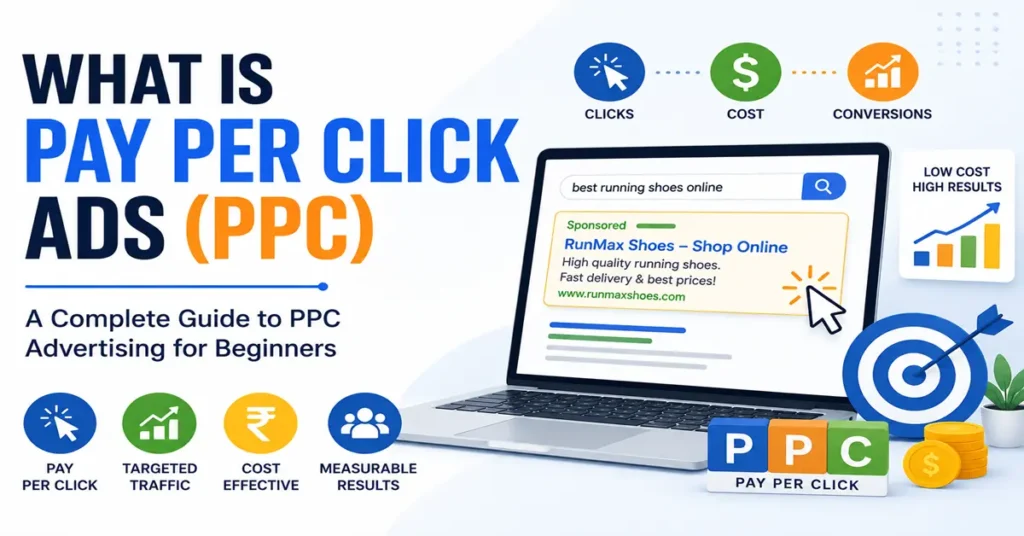
Pay Per Click, commonly called PPC, is a digital advertising model in which advertisers pay when someone clicks on their advertisement. Instead of paying a fixed amount simply to display an advertisement, businesses generally pay for the traffic generated through clicks.
PPC advertising is widely used by businesses, bloggers, e-commerce stores, service providers, and marketers because it can help bring targeted visitors to a website relatively quickly.
In this guide, we will explain what is Pay Per Click ads, how PPC works, how much it can cost, the different types of PPC advertising, its advantages and disadvantages, and how beginners can get started.
Table of Contents
What Is Pay Per Click Ads?
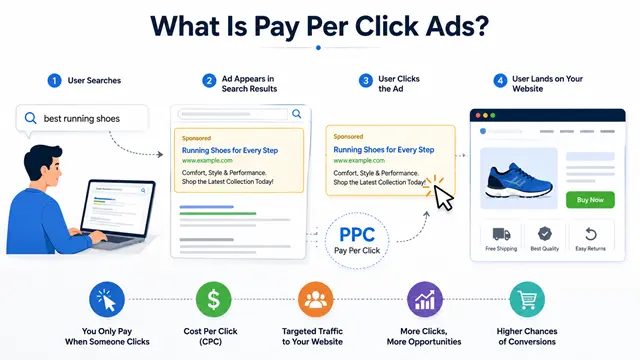
Pay Per Click ads are online advertisements where an advertiser pays a fee when a user clicks on the advertisement.
The basic idea is simple:
You create an advertisement → Someone searches or browses online → Your ad is displayed → The person clicks → You pay for that click.
For example, imagine that you own a website selling running shoes.
You could create a PPC advertisement targeting people searching for:
- Best running shoes
- Buy running shoes online
- Running shoes for beginners
- Men’s running shoes
- Women’s running shoes
If your advertisement appears for a relevant search and someone clicks on it, the advertising platform may charge you for that click.
This is why the advertising model is called Pay Per Click.
You are paying for clicks rather than simply paying for the number of times your advertisement is shown.
How Does Pay Per Click Advertising Work?
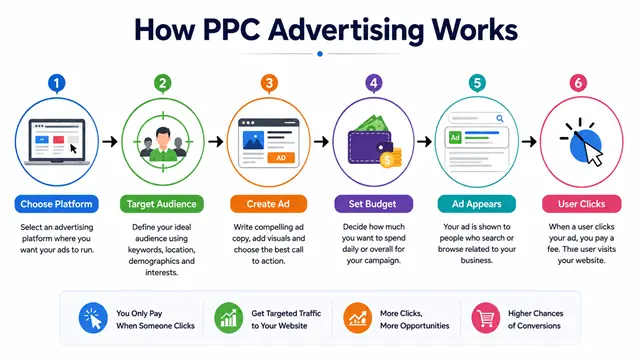
PPC advertising may look simple from the outside, but several processes happen behind the scenes.
A typical PPC campaign works like this:
Step 1: Choose Your Advertising Platform
The first step is deciding where you want your advertisement to appear.
Popular PPC advertising platforms include:
- Google Ads
- Microsoft Advertising
- Meta Ads
- LinkedIn Ads
- Amazon Ads
The best platform depends on your target audience and business.
For example, a local plumber might find search advertising useful because people actively search for plumbing services. An online clothing brand might use social media advertising to reach people based on interests and shopping behavior.
Step 2: Choose Your Target Audience
You then decide who should see your advertisements.
Depending on the platform, targeting can include factors such as:
- Keywords
- Location
- Age
- Interests
- Devices
- Search behavior
- Demographics
- Previous website activity
Good targeting helps prevent your advertising budget from being wasted on people who are unlikely to become customers.
Step 3: Create Your Advertisement
The next step is creating the actual ad.
A PPC ad usually contains a combination of:
- Headline
- Description
- Image or video, depending on the ad format
- Call to action
- Website or landing page
For example:
Headline: Affordable Running Shoes Online
Description: Shop comfortable running shoes for beginners and professionals. Explore the latest collection today.
Call to Action: Shop Now
The advertisement should clearly communicate what the user will get after clicking.
Step 4: Set Your Budget
You decide how much you are willing to spend.
For example, a business might set a daily advertising budget of ₹500.
The actual amount spent depends on the campaign settings, platform, competition, clicks, and other factors.
Step 5: The Advertising Platform Shows Your Ad
When someone performs a relevant search or meets the targeting criteria, the platform decides which advertisements are eligible to appear.
For search advertising, this often involves an auction system.
Advertisers compete for opportunities to show their ads for particular searches or keywords.
Step 6: You Pay When Someone Clicks
If a user clicks your advertisement, you may be charged according to the campaign’s pricing model.
This is the basic principle behind Pay Per Click advertising.
Example of Pay Per Click Advertising
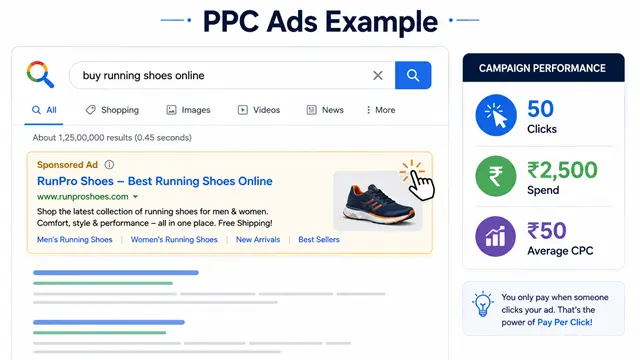
Let’s understand PPC with a simple example.
Suppose you own a digital marketing agency in Delhi.
You create a Google Ads campaign targeting the keyword:
digital marketing agency in Delhi
Your advertisement appears when people search for related terms.
Suppose:
- 1,000 people see your advertisement
- 50 people click it
- You spend ₹2,500
- You receive 50 website visits
Your average cost per click would be:
₹2,500 ÷ 50 = ₹50 per click
So your average CPC is ₹50.
This does not mean every click necessarily costs exactly ₹50. Actual costs can vary depending on the advertising platform, competition, keyword, targeting, ad quality, and other campaign factors.
What Is CPC in PPC Advertising?
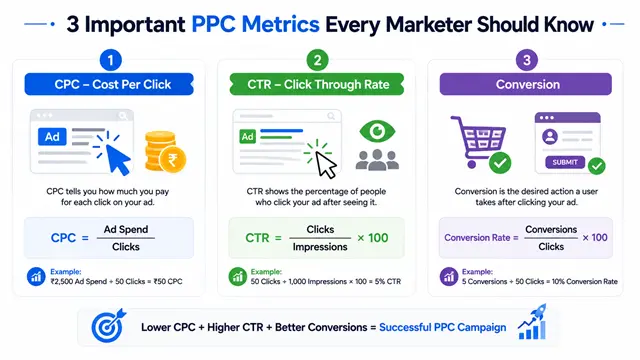
CPC stands for Cost Per Click.
It refers to the amount an advertiser pays for a click on an advertisement.
For example, if you spend ₹1,000 and receive 20 clicks:
CPC = ₹1,000 ÷ 20 = ₹50
So your average cost per click is ₹50.
CPC is one of the most important metrics in a PPC campaign because it helps advertisers understand how much they are spending to generate traffic.
However, a low CPC does not automatically mean a campaign is successful.
You also need to consider what happens after people click.
What Is CTR in PPC?
CTR means Click-Through Rate.
It measures how often people click an advertisement after seeing it.
The basic formula is:
CTR = (Clicks ÷ Impressions) × 100
For example, if your ad receives:
- 1,000 impressions
- 50 clicks
Your CTR would be:
5%
A higher CTR can indicate that an advertisement is relevant and attractive to the audience, although the ideal CTR varies considerably by platform, campaign type, industry, keyword, and audience.
What Is Conversion in PPC Advertising?
A click is not always the final goal.
Most businesses run PPC campaigns because they want users to take a valuable action.
This action is called a conversion.
A conversion could be:
- Buying a product
- Filling out a contact form
- Calling a business
- Signing up for a newsletter
- Downloading an ebook
- Booking an appointment
- Creating an account
- Requesting a quote
For example, if 100 people click your advertisement and 5 purchase your product, you have generated 5 conversions.
This is why successful PPC advertising should focus on more than clicks.
The real goal is usually to generate valuable actions from the right audience.
What Are the Main Types of PPC Advertising?
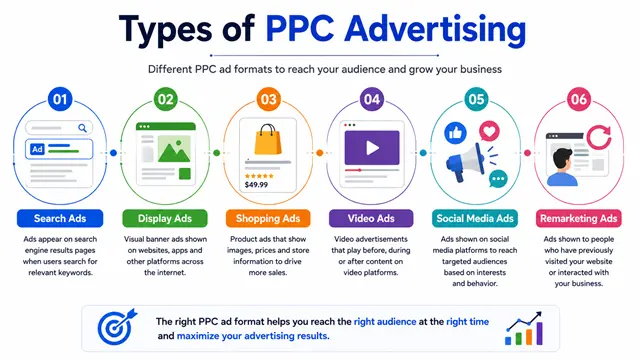
PPC is not limited to one type of advertisement. Businesses can use several different PPC formats.
1. Search Ads
Search ads appear when users search for relevant keywords on search engines.
For example, someone searches:
buy laptop online
A relevant sponsored result may appear near the top of the search results.
Search ads are particularly useful when people are already looking for a product, service, or solution.
2. Display Ads
Display advertising uses visual advertisements that can appear across websites and apps within an advertising network.
These advertisements can include:
- Images
- Text
- Banners
- Interactive elements
Display campaigns can be useful for building awareness, promoting products, or reaching people based on their interests and behavior.
3. Shopping Ads
Shopping ads are designed primarily for products.
They can display information such as:
- Product image
- Product name
- Price
- Store name
For an online store, shopping advertising can be useful because users can see important product information before clicking.
4. Video Ads
Video advertising allows businesses to promote products and services through video.
These ads can appear on video platforms and other websites or apps that support video advertising.
Video PPC campaigns can be useful for:
- Product demonstrations
- Tutorials
- Brand awareness
- App promotion
- Promotional campaigns
5. Social Media Ads
Social media platforms also offer paid advertising.
Businesses can create campaigns to reach audiences based on factors such as interests, demographics, behavior, and other targeting options offered by the platform.
Social media advertising can be useful for brands that want to introduce products to people who may not be actively searching for them yet.
6. Remarketing Ads
Remarketing, also called retargeting in many advertising contexts, allows businesses to reach people who have previously interacted with their website, app, or content, subject to platform policies and user privacy controls.
For example, someone visits an online store but does not purchase a product.
A business may later show that person another advertisement related to the products they viewed.
The goal is to bring interested visitors back and encourage them to complete an action.
What Is Google PPC Advertising?
Google PPC advertising generally refers to paid advertising through Google Ads.
Businesses can create campaigns that may appear across Google’s advertising ecosystem, depending on the campaign type and settings.
One of the most familiar forms is search advertising.
For example, suppose someone searches:
best SEO agency in India
A business targeting relevant search terms may compete for an opportunity to show an advertisement.
The advertiser may then pay when someone clicks the ad, depending on the campaign’s bidding and charging setup.
Google Ads also supports other campaign formats, including display, video, shopping, app, and other advertising solutions.
How Much Does PPC Advertising Cost?
There is no single fixed price for PPC advertising.
The cost can vary significantly depending on:
- Industry
- Keyword competition
- Location
- Audience
- Advertising platform
- Campaign objective
- Ad quality
- Landing page experience
- Bidding strategy
- Competition
For example, keywords related to insurance, finance, legal services, and business services can be highly competitive in some markets.
A less competitive niche may have lower advertising costs.
You can start with a small budget and increase spending after identifying campaigns that generate useful results.
Is PPC Expensive?
PPC is not necessarily expensive, but poorly managed PPC can become expensive.
Imagine you spend ₹5,000 on advertisements and receive thousands of low-quality visits but no customers.
That campaign may not be profitable even if the traffic numbers look impressive.
On the other hand, a smaller campaign that spends ₹2,000 but generates several valuable customers could be much more successful.
This is why PPC should be measured against business goals rather than clicks alone.
What Is Quality Score in PPC?
For Google Search campaigns, Quality Score is a diagnostic metric that provides insight into the quality and relevance of keywords, ads, and landing pages.
Factors related to the experience can include:
- Expected click-through rate
- Ad relevance
- Landing page experience
A relevant advertisement and useful landing page can help create a better experience for users.
However, Quality Score should not be treated as the only measure of PPC performance.
What Is a Landing Page in PPC?
A landing page is the webpage a visitor reaches after clicking an advertisement.
For example, imagine your advertisement says:
Get 20% Off Running Shoes
If the user clicks the advertisement and arrives on a page showing the same offer with clear product information and an easy purchasing process, the experience is more consistent.
A good landing page should generally have:
- A clear headline
- Relevant information
- Fast loading
- Mobile-friendly design
- Strong call to action
- Simple navigation
- Trust signals
- Relevant offer
Sending every PPC visitor to a generic homepage is not always the best strategy.
PPC vs SEO: What Is the Difference?
PPC and SEO can both bring visitors to a website, but they work differently.
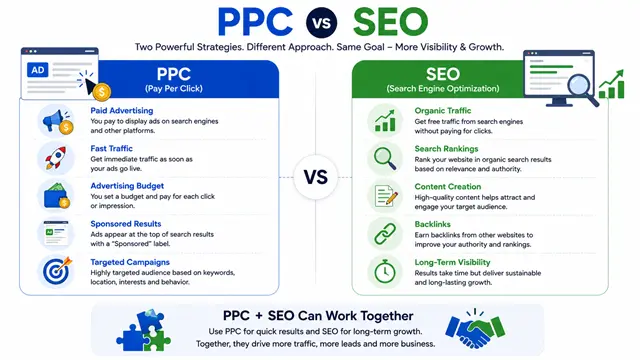
| PPC | SEO |
|---|---|
| Paid advertising | Organic search optimization |
| Traffic can start quickly after campaigns launch | Results usually take time |
| You pay for advertising | Organic clicks don’t have a direct per-click ad charge |
| Budget controls advertising spend | Requires ongoing optimization and content work |
| Ads stop when campaigns stop or budgets/settings prevent delivery | Organic visibility can continue without paying for each click |
| Useful for immediate campaigns | Useful for long-term organic visibility |
The two strategies do not have to compete with each other.
Many businesses use SEO and PPC together.
Advantages of Pay Per Click Advertising
PPC has several advantages when campaigns are properly planned and managed.
1. Fast Traffic
Unlike SEO, which can take time to build organic visibility, paid advertising can start generating impressions and clicks once campaigns are approved and running.
2. Targeted Audience
Advertisers can often target specific keywords, locations, audiences, devices, or other criteria depending on the platform.
3. Measurable Results
PPC platforms provide data that can help advertisers evaluate:
- Impressions
- Clicks
- CTR
- CPC
- Conversions
- Conversion rate
- Advertising spend
4. Budget Control
Advertisers can set budgets and campaign limits according to their objectives and platform options.
5. Useful for New Businesses
A new business without strong organic rankings can use paid advertising to reach potential customers while it works on long-term SEO.
Disadvantages of PPC Advertising
PPC also has limitations.
1. It Costs Money
Every successful campaign requires an advertising budget.
2. Traffic Can Stop
If you stop your advertising campaign, the paid traffic generated by that campaign can also stop.
3. Competition Can Be High
Popular keywords can attract many advertisers, which can increase competition.
4. Poor Targeting Can Waste Money
If your advertisement reaches people who are unlikely to become customers, your budget may be spent without producing useful results.
5. Requires Regular Management
PPC campaigns often need ongoing monitoring, testing, optimization, and analysis.
How to Start a PPC Campaign
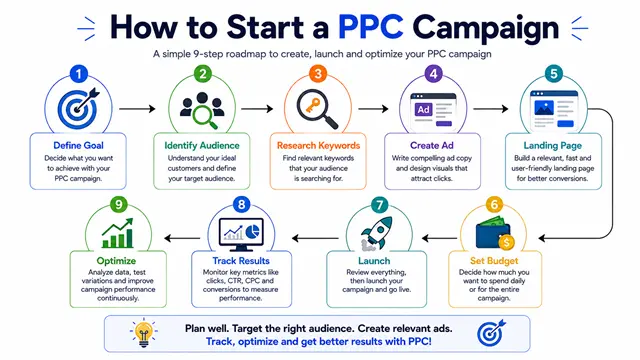
If you are a beginner, you can follow a simple process.
Step 1: Define Your Goal
Decide what you want to achieve.
For example:
- Website traffic
- Leads
- Sales
- Phone calls
- App installations
Step 2: Identify Your Audience
Understand who your ideal customer is.
Step 3: Research Keywords
If you are running search advertising, identify keywords relevant to your products or services.
Step 4: Create Your Advertisement
Write a clear headline and description that match the user’s search intent.
Step 5: Build a Relevant Landing Page
Make sure the landing page provides exactly what the advertisement promises.
Step 6: Set Your Budget
Choose a budget appropriate for your business and campaign goals.
Step 7: Launch the Campaign
Review your targeting, advertisements, keywords, tracking, and budget before launching.
Step 8: Monitor the Results
Track important metrics and identify which campaigns, advertisements, keywords, or audiences are producing useful results.
Step 9: Optimize
Pause poor-performing elements and improve campaigns based on actual data.
PPC Mistakes Beginners Should Avoid
Many beginners make the mistake of focusing only on getting clicks.
Here are some common PPC mistakes:
Using Irrelevant Keywords
Targeting keywords that have little connection to your product can waste money.
Sending Visitors to the Wrong Page
If the ad promotes one product but the visitor lands on an unrelated page, they may leave immediately.
Ignoring Mobile Users
Many people browse and shop using smartphones, so mobile experience matters.
Not Tracking Conversions
Without conversion tracking, it can be difficult to know whether your advertising is actually producing business results.
Setting a Budget Without a Goal
A budget alone does not make a campaign successful. You need to know what you expect the campaign to accomplish.
Never Testing Your Ads
Testing different headlines, offers, audiences, keywords, and landing pages can help you understand what works better.
Is PPC Good for Small Businesses?
Yes, PPC can be useful for small businesses, particularly when advertising is targeted carefully.
For example, a local restaurant could target people searching for restaurants in its service area.
A dentist could advertise searches related to dental services in a particular city.
An online store could promote specific products to people who are already searching for them.
The key is to start with a manageable budget, track results, and avoid spending heavily before understanding what works.
Is PPC Better Than SEO?
There is no universal answer.
PPC is useful when you want targeted paid traffic and are willing to pay for advertising.
SEO is useful when you want to build organic search visibility over time.
For many businesses, the best approach is not choosing one over the other.
A combined strategy can use PPC for immediate visibility while SEO builds long-term organic traffic.
What Is the Difference Between PPC and CPC?
PPC and CPC are related but not identical terms.
PPC describes an advertising model where the advertiser pays based on clicks.
CPC refers to the cost associated with a click.
For example:
If you run a PPC campaign and spend ₹1,500 for 30 clicks:
Average CPC = ₹1,500 ÷ 30 = ₹50
So PPC is the advertising model, while CPC is a measurement of click cost.
Frequently Asked Questions
What is Pay Per Click ads?
Pay Per Click ads are online advertisements where advertisers generally pay when users click on their advertisements. PPC is widely used in search engines, social media, display advertising, shopping campaigns, and other digital advertising formats.
What does PPC stand for?
PPC stands for Pay Per Click.
How does PPC work?
An advertiser creates a campaign, selects targeting options, sets a budget, creates advertisements, and competes for opportunities to display those ads. When users click qualifying ads, the advertiser may be charged according to the campaign’s pricing and bidding setup.
Is PPC the same as Google Ads?
Not exactly. PPC is an advertising model, while Google Ads is an advertising platform. Google Ads offers several campaign types, including formats where advertisers may pay based on clicks, impressions, conversions, or other actions depending on the campaign.
How much does Pay Per Click advertising cost?
There is no fixed PPC price. Cost depends on factors such as competition, industry, location, targeting, keywords, platform, bidding strategy, and campaign performance.
Is PPC good for beginners?
Yes. Beginners can start with a small, controlled campaign, learn from the data, and gradually optimize their advertising strategy.
Can PPC help a new website?
Yes. PPC can help a new website generate targeted paid traffic while the website works on longer-term SEO and organic visibility.
What is a good PPC strategy?
A good PPC strategy starts with a clear business goal, relevant targeting, strong advertisements, useful landing pages, conversion tracking, controlled spending, and regular optimization.
Final Thoughts
So, what is Pay Per Click ads?
In simple terms, PPC is a digital advertising model where businesses pay for clicks on their advertisements. It can help companies reach people who are searching for products or services, discover new audiences, generate leads, and increase online sales.
However, successful PPC advertising is not simply about getting as many clicks as possible. The real objective is to attract the right visitors and turn those visitors into meaningful actions such as purchases, enquiries, calls, or registrations.
For beginners, the best approach is to start small, choose a clear goal, target a relevant audience, create useful advertisements, track conversions, and improve the campaign using real performance data.
When combined with a strong SEO and content marketing strategy, PPC can become an effective part of a broader digital marketing plan.
Read More………..
What is Digital Marketing? Complete Beginner Guide (2026)
Content Marketing Strategy: Complete Guide for Beginners
LinkedIn Marketing: A Complete Beginner’s Guide (2026)
YouTube Marketing: A Complete Beginner’s Guide (2026)
Instagram Marketing: A Complete Beginner’s Guide (2026)
Facebook Marketing: A Complete Beginner’s Guide (2026)
What Is Affiliate Marketing? A Complete Beginner’s Guide (2026)
What Is Social Media Marketing? A Complete Beginner’s Guide (2026)
What Is Email Marketing? A Beginner’s Guide to Growing Your Business
What Is Deep Learning? A Complete Beginner’s Guide (2026)
AI vs Machine Learning vs Deep Learning: What’s the Difference? (2026)
What Is Pay Per Click Advertising? A Complete Beginner’s Guide (2026)
Google Analytics 4 (GA4): A Complete Beginner’s Guide (2026)